A Prodigy's Lesson for Marketers

285.
You have heard it a thousand times: play Mozart for your baby and watch the genius unfold. An entire industry was built on it. There is just one problem. It was never true.
In 1993, researchers played ten minutes of a Mozart piano sonata for 36 college students, then tested their spatial reasoning (Rauscher et al., 1993). Scores ticked up a few points, and the effect vanished within fifteen minutes. The media turned that single finding into "Mozart makes babies smarter," companies sold millions of Baby Einstein videos, and one state even proposed handing out classical CDs to newborns, all while the lead researcher spent years publicly disavowing what her study became. A later meta-analysis found the real effect was tiny, limited to one type of task, and fully explained by the fact that the students simply enjoyed what they heard (Chabris, 1999). An entertaining passage from a Stephen King novel did the same thing.
Here is what actually builds a brain: practice.
In 2009, neuroscientists scanned the brains of six-year-olds before and after fifteen months of weekly piano lessons (Hyde et al., 2009); the music kids showed measurable growth in the brain regions tied to hearing and movement, and the growth tracked with how much their playing improved. Nobody got smarter by listening, because the kids who did the work physically rebuilt their brains. That distinction (listening versus doing) is why I wanted to tell you about Abigail Huang, who is the training effect in human form. She started piano at three and a half and by six, she had mastered nearly one hundred classical pieces entirely by ear, before she could even read music, with perfect pitch. Twelve-plus years of practice built the brain that now takes the stage.
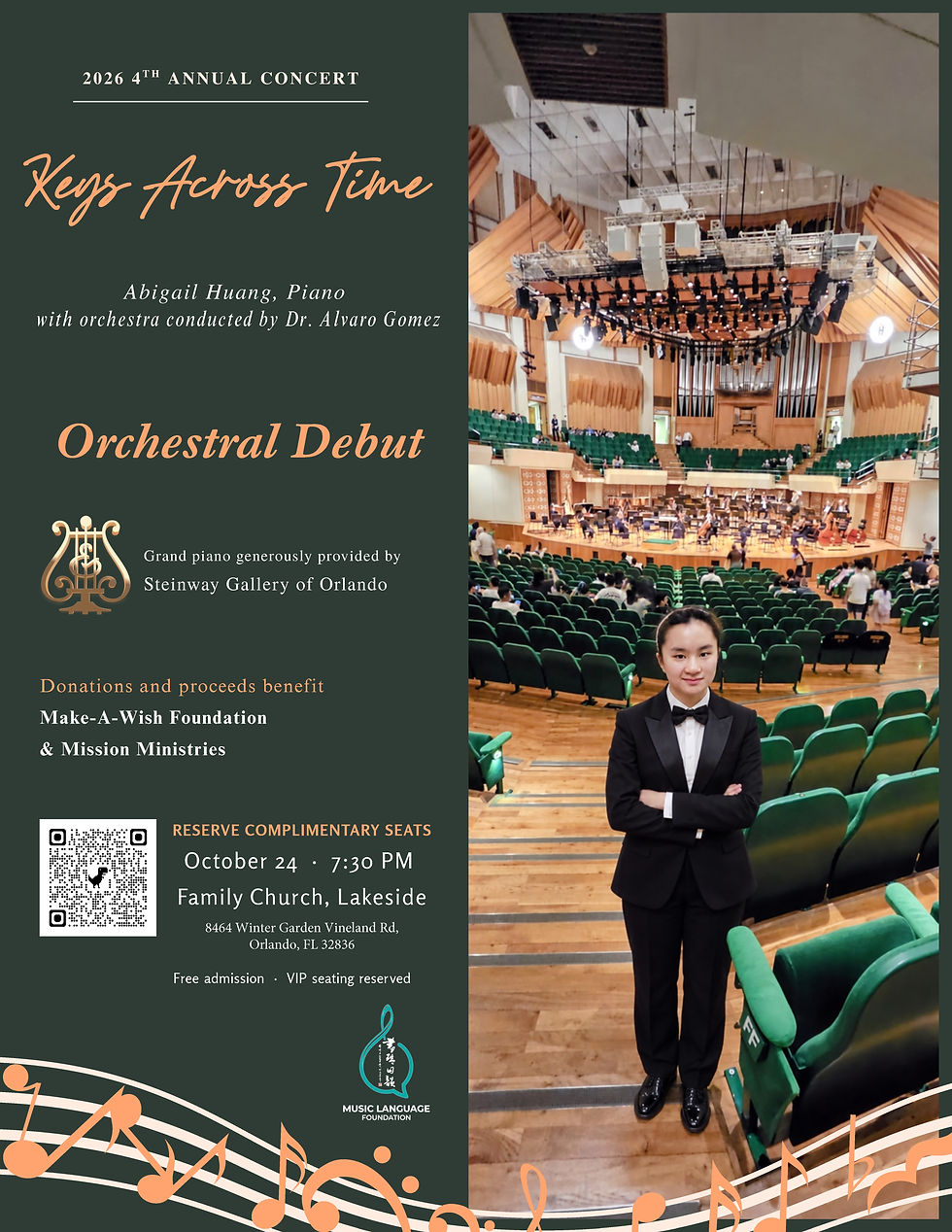
On October 24, this sixteen-year-old makes her orchestral debut in Orlando, performing on a Steinway Model D with a full orchestra behind her.

There is a marketing lesson buried in here, and it is the same one I give my clients. Passive consumption never built anything; saving tips, watching tutorials, and buying the software is just listening to Mozart and waiting to get smarter. Mastery comes from reps. The algorithm rewards the people who show up and do the work, and so does your audience.
If you want to watch twelve years of reps pay off in real time, come see it. "Keys Across Time," Abigail Huang's fourth annual concert and orchestral debut, is Saturday, October 24 at 7:30 PM at Family Church in Orlando. My Florida media team will be there capturing every moment while I cheer from the West Coast. Come hear what built brain sounds like with free admission where donations benefit selected nonprofits. If you cannot make it to Orlando, I would still love to hear from you. Drop a comment below and let me know: what is one skill you have mastered through sheer repetition?
References
Chabris, C. F. (1999). Prelude or requiem for the "Mozart effect"? Nature, 400(6747), 826–827. https://doi.org/10.1038/23608
Hyde, K. L., Lerch, J., Norton, A., Forgeard, M., Winner, E., Evans, A. C., & Schlaug, G. (2009). Musical training shapes structural brain development. The Journal of Neuroscience, 29(10), 3019–3025. https://doi.org/10.1523/JNEUROSCI.5118-08.2009
Rauscher, F. H., Shaw, G. L., & Ky, K. N. (1993). Music and spatial task performance. Nature, 365(6447), 611. https://doi.org/10.1038/365611a0

- Kristina Bozanich - I am a fractional CMO, media producer, Congressional Record Honoree, and LGBTQ+ Advocate. To see more updates, follow on social media or sign up for email subscriptions.


Comments